It is May 3, 2009 in Manila.
Osmeña Highway, normally a whirlwind of buses and jeepneys, is nearly empty. Drivers have pulled over to listen. Families are packed around televisions. The Metro Manila police will report something that sounds impossible in a metropolis that large: no major crimes and no traffic accidents during the fight.
Manny "Pac-man" Pacquiao drops Ricky Hatton twice in the first round. The fight lasts five minutes and 59 seconds. For those 359 seconds, a country seems to breathe through one pair of lungs. With one second left in the second round, the Filipino southpaw detonates a left hand and leaves Hatton flat on the ground. Then the roads refill, horns begin to blare, and Philippine flags wave from moving cars (ABC’s fight report / celebrations in the Philippines / Philstar’s Metro Manila report).
Manny was an eight-division world champion; his legacy is hard to trump for any sportsperson in the world. However, a certain rising player in the WTA is bringing back glimpses of the legendary Pac-man to the sports community again.
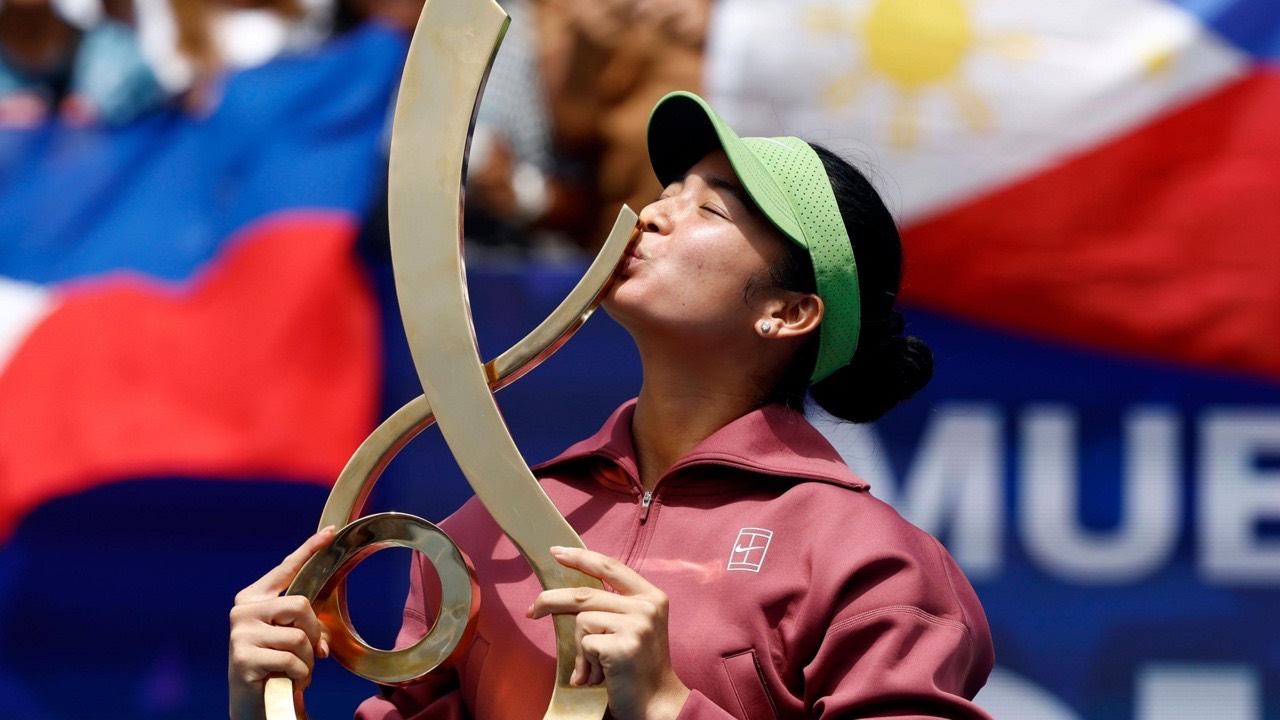
That would be none other than Alexandra Eala, a 21 year-old professional tennis player originally from Quezon City, Philippines. After her victory at the Washington DC Open, she achieved a career-high singles ranking of world No. 20, marking the higest ranking ever for a Filipino in WTA history (Washington final report). Her electric baseline game and on-court creativity is bringing together the Filipino community worldwide.
The clearest evidence arrived days later in Toronto. Tickets for her opening session sold out in 30 minutes, many bought by people attending their first professional tennis tournament. Inside a stadium of just over 10,000 were Philippine flags, an adobo rice bowl created for the occasion, and an unusually clear "home favorite" at a neutral-site WTA match. Tournament officials had already conceded that a 2,800-seat court would be far too small for her (The Athletic / AS on Toronto demand).
Eala is 36–18 across all WTA levels in 2026 and owns the first tour-level singles title won by a Filipino. Additionally, she has won some enormous matches this season, shown by her extraordinary 7–2 record against Top 10 opponents. Her season is a genuine breakthrough.
Recency bias is a real thing in sports, so I'm hesitant to call her a "Tier 1" player just yet. However, it has been made clear that she can remain in the Top 20–30 conversations. Regardless, she is one of the most exciting players in tennis right now.
All results and rankings are current through 1:40 p.m. Eastern Time on August 7, before Eala’s scheduled Toronto third-round match against Caty McNally. WTA Tour statistics exclude WTA 125 events unless stated otherwise. The official season table was current through Washington; the calculations below add Eala’s August 5 win over Alycia Parks from the Toronto match box score.
2026: A breakthrough season for Eala
Eala did not quite appear from nowhere in 2026. She won the US Open junior title in 2022, became the first Filipina to win a Grand Slam main-draw singles match at the 2025 US Open, and announced herself to the tour by reaching the 2025 Miami semifinal (US Open junior recap / US Open 2025 profile). However, this is the first season where she has been able to consistently produce those eye-catching results.
She opened the season with an Auckland semifinal and quarterfinals in Abu Dhabi and Dubai, collecting her first 2026 Top-10 win over No. 8 Jasmine Paolini. March produced fourth rounds at both Indian Wells and Miami, along with a 6-2, 2-0 lead over No. 4 Coco Gauff before Gauff retired. She had a slight struggle on clay, with a disappointing 4-6 clay swing and a first-round exit at Roland Garros.
Eala bounced back on Grass, winning the Birmingham WTA 125 title in June and defeating No. 2 Elean Rybakina and No. 8 Elina Svitolina en route to a Berlin semifinal. Weeks later, she made the Wimbledon fourth round in July after defeating defending champion and No. 3 Iga Swiatek. Washington followed immediately, where she fought through a gauntlet of Zheng Qinwen, Leylah Fernandez, Svitolina, Naomi Osaka, and No. 3 Jessica Pegula to hoist the title in DC. On August 5, she opened her Toronto campaign by beating Alycia Parks 6-1, 4-6, 6-2.
Eala has 2,106 points in the August 3 official rankings and 1,878 in the 2026 Race—89.2 percent as many. For the non-tennis fans: No. 20 describes the last 12 months; No. 14 shows her ranking for this season alone (WTA rankings; official Race standings).
The record carries another useful split. On the main tour she is 29–17, beating 21 of 25 opponents ranked outside the Top 50 while going 15–14 against the Top 50. She is starting to make ordinary wins pretty routine (WTA match history). She has also done what a Top-20 player should do in the lower levels, going 7–1 across eight WTA 125 matches while holding 80.7 percent of service games and breaking 45.6 percent of return games (WTA statistics).
The serve made the leap possible
Eala is listed at 5-foot-9, but her serve has never been a Sabalenka-like weapon that ends points quickly. Her advantage begins on the second ball. She loves to take the ball early, redirects pace with a compact left-handed swing, and changes direction fluidly. The flat timing that made her dangerous as a teenager now survives against heavier shots for longer stretches. The transformational 2026 change is that her serve gives that timing a better starting position.
| Tour-level metric | 2025 | 2026 so far | Change |
|---|---|---|---|
| First serves in | 67.1% | 63.0% | -4.1 pts |
| First-serve points won | 57.9% | 63.0% | +5.1 pts |
| Second-serve points won | 46.5% | 47.7% | +1.2 pts |
| All service points won | 54.1% | 57.4% | +3.3 pts |
| Service games held | 58.7% | 67.6% | +8.9 pts |
| Aces per service point | 1.2% | 2.0% | +0.8 pts |
| Double faults per second-serve attempt | 12.3% | 10.1% | -2.2 pts |
| Break points saved | 52.2% | 54.8% | +2.6 pts |
| First-serve return points won | 39.4% | 36.6% | -2.8 pts |
| Second-serve return points won | 59.0% | 56.9% | -2.1 pts |
| Return points won | 46.5% | 44.4% | -2.1 pts |
| Return games won | 41.4% | 36.7% | -4.7 pts |
| Break points converted | 46.3% | 41.4% | -4.9 pts |
| All points won | 50.3% | 50.8% | +0.5 pts |
Above calculations use the WTA’s official serve-and-return counts (Eala’s WTA statistics). She is landing fewer first serves but winning about five percentage points more often when she does. Her ace rate has risen only from 1.2 to 2.0 percent, so the gains clearly come from placement, getting a shorter return from her opponent, and beginning the next shot on the offense. She has also cut double faults as a share of second-serve attempts by about one-fifth.
The result is almost nine extra holds per 100 service games, a massive improvement. In 2025, a 58.7 percent hold rate forced her return game to rescue her constantly. In 2026, 67.6 percent lets a single break decide a set. At Wimbledon, she beat Swiatek 7-6(9), 6-2 while winning 55 percent of her second-serve points. Afterward, Eala identified the serve as the part of her game that had moved forward (WTA match report).
There is a cost. Her return and break rates have all slipped, and a lot of that is opponent quality. A full tour schedule contains many more Rybakina and Pegula serves than the lower-level events Eala once played. Some may reflect a more aggressive court position and a willingness to miss while taking time away. Either way, her total-point share has moved only from 50.3 to 50.8 percent.
That last number is my first warning light. Tennis is scored in games and sets, not a season-long pile of points, so a player can outperform her point share through timing and matchup skill. But the best players eventually create separation. Most current Top-20 players win roughly 52.5 to 54.5 percent of all points. Eala is winning barely more than half.
Dissonance in the statistics
Among the 78 current Top-100 players with at least 20 tour-level matches in the WTA’s 2026 statistical database, Eala’s updated rates place her roughly here:
| Metric | Eala | Peer rank | Top-100 sample average |
|---|---|---|---|
| Total points won | 50.8% | 35th of 78 | 50.6% |
| Service points won | 57.4% | about 40th | 57.7% |
| Return points won | 44.4% | about 31st | 43.6% |
| Service games held | 67.6% | about 38th | 67.6% |
| Return games won | 36.7% | about 31st | 35.2% |
| First-serve points won | 63.0% | about 54th | 64.7% |
| Second-serve points won | 47.7% | about 22nd | 45.9% |
| Break points converted | 41.4% | about 69th | 45.5% |
The ranks are my calculations from the WTA’s player statistics. They say Eala has a solid return and an unusually dependable second serve, but neither a dominant first delivery nor the combined serve-return ability associated with the top of the rankings. Her 1.09 hard-court dominance ratio—her return-point share divided by opponents’ return-point share against her serve—is good. It is not phenomenal.
Yet, opponent-adjusted ratings see far more. Tennis Abstract's August 3 Elo table ranked Eala 13th overall, 13th on hard courts and eighth on grass, against 60th on clay. Elo rewards whom a player beats and how recently (Tennis Abstract Elo ratings). Seven wins in nine Top-10 matches thus matter enormously. The point data says “good Top-40 player.” The opponent-adjusted results say “borderline Top-10 player.” Her present ranking splits the difference.
Furthermore, though Eala is 7–2 against the Top 10 and 4–2 against the Top 5, (officially the best Top-10 winning percentage on tour through Washington), against players ranked 11th through 20th, she is 1–7, losing to Linda Noskova, Iva Jovic, and Paolini (WTA's 2026 "By the Numbers" report). It is important to remember that nine Top-10 matches and eight against Nos. 11–20 are tiny samples, vulnerable to retirements, form, and a few break points.
Chances at the US Open
Eala’s surface data supplies the clearest reason for optimism.
| 2026 tour surface | Record | Service points won | Hold | Return points won | Break | Total points won |
|---|---|---|---|---|---|---|
| Hard | 18–7 | 58.3% | 68.3% | 45.5% | 38.8% | 51.6% |
| Clay | 4–6 | 54.2% | 60.8% | 43.0% | 33.0% | 49.0% |
| Grass | 7–4 | 58.4% | 72.1% | 42.9% | 35.2% | 50.7% |
Her grass record becomes 12–4 when Birmingham’s WTA 125 title is included. Grass amplifies her early contact, low trajectory, and left-handed patterns, shown by her hold rate jumping above 72 percent. But the hard court brings a more complete game out of her. She wins more return points there without giving back the service improvement, producing her best 2026 tour-level point share and a 1.09 dominance ratio.
New York also carries winning memories. Eala won the girls' title there in 2022, and in 2025 came from a set down to beat Clara Tauson for the Philippines' first Grand Slam main-draw singles win. This year she arrives seeded. If her ranking holds between 17th and 24th, placement rules keep her away from the Top 8 until the fourth round and put a No. 9–16 seed in her third-round path (2026 Grand Slam rulebook). This will allow her to settle in before fighting the top guns. Cincinnati can still move the seedings before play begins August 30 (US Open schedule).
Before seeing the draw, my opponent-neutral forecast is that she makes the third or fourth round. Reaching the second week would be a very successful tournament. A quarterfinal appearance is plausible and wouldn't surprise me, but it is not expected.
Three things could end the run earlier.
First, the serve. A 68.3 percent hard-court hold is much better than last year, but major contenders hold in the mid-70s or higher, and Eala still wins a below-average 63 percent behind her first delivery, leaving too many games at 30-30. Parks showed the volatility in Toronto: Eala won 32 of 45 first-serve points but hit six double faults and lost both break points she faced, recovering only by generating 14 chances on return (Toronto scores).
Second, physical accumulation. 54 singles matches plus doubles before Toronto's third round, with Cincinnati and then New York immediately after. Her compact strokes save some energy; however, the repeated three-setters and the emotional tax of being every tournament's unofficial home player do not (shoutout to her fanbase).
Third, tactical patience. Her ball striking is most dangerous when she steals time from a stable position. Against opponents that push her behind the baseline, redirecting every ball turns an advantage into rushed errors. Paolini, Jovic, and Noskova have all absorbed the first change of direction and neutralized Eala's best efforts.
The next threshold is thus clear. To look like a Top-10 player rather than a "potentially dangerous" Top-20 seed, Eala needs a hold rate near 74 or 75 percent while keeping return points above 44, which should lift her total-point share past 52. If these gains arrive, Tennis Abstract's No. 13 ELO ranking will start to look a lot more realistic.
The Eala Effect
Toronto wasn't the first big showing for the Eala fan club. The Australian Open was overwhelmed by the crowd around its small Court 6 (WTA). A BBC analysis found that Eala’s news conference generated 171,000 views, around six times the comparable Alcaraz or Gauff figure (BBC).
At Indian Wells, supporters waited for hours and some were learning tennis scoring in real time (ESPN on the “Eala Effect”). After the grass season, Eala received nearly 90 percent of a WTA fan vote for “Star of the Swing,” finishing ahead of actual Wimbledon champion Linda Noskova (WTA fan vote).
The scale of this support makes sense. The Philippines has roughly 113 million people and a vast diaspora (Los Angeles Times). Before Eala, no Filipina had cracked the Top 100 (WTA rankings report). She first learned tennis on a makeshift half-basketball court (Los Angeles Times), then moved to the Rafa Nadal Academy at 13 (WTA interview). She is a left-hander with an intelligent game, speaks with charisma in front of the press, and competes beneath a flag that tennis hasn't often broadcasted.
The echoes of Pacquiao rings loud in that way. His fights offered Filipinos at home and abroad a reason to unite. Whatever the time zone, everyone knew where to look. Eala is beginning to have a similar effect, drawing thousands at a watch party for her Wimbledon run in Manila.
But Eala is changing this sensation in the right ways too. The athlete at center stage this time is a young woman, and the product newcomers are buying is women’s tennis. Eala has said that many of her supporters are being introduced not only to her but to the women’s game, and Gauff called the new audience “great for the sport” (Tennis.com / WTA International Women’s Day feature).
New spectators come to see Eala and leave having watched Pegula, Osaka, Svitolina, Swiatek, or Gauff. Girls see a Filipino woman as the main event, not a supporting act.
There will be growing pains. Melbourne spectators unfamiliar with tennis etiquette shouted between serves, and Parks needed security help leaving the court after beating Eala. The challenge for tournaments is to welcome an enormous first-time crowd, explain the norms the right way, and give those fans reasons to return even after Eala loses (WTA’s Australian Open report).
The longer test in the Philippines is whether this spark becomes long-term infrastructure: public courts, affordable coaching, equipment, junior competition, and another child who can imagine following her. Eala cannot build that system alone.
At Wimbledon she wore a visor embroidered with a Tagalog line she translated as, "Once it grows, it cannot be stopped" (WTA). She was describing Filipino identity, but it works just as well as a description of what she has started. The season isn't close to over for Eala.