Miomir Kecmanovic had found the opening.
On the first Monday of Wimbledon, the defending champion looked shaky on Centre Court. Jannik Sinner lost the opening set, recovered in the second, then dropped a third-set tiebreak to fall behind two sets to one. He had not played an official match since his physically troubling Roland Garros exit, and the rust showed in 52 unforced errors.
Kecmanovic’s real achievement was keeping the score close enough for those errors to matter. Even on a bad day, Sinner hit 31 aces, won 89 percent of first-serve points and 71 percent behind his second serve. Kecmanovic broke him only once, but held 19 of 23 service games and captured the tiebreak. Then Sinner started reducing errors, won the final two sets 6-2, 6-3 and escaped (ATP match report; match statistics).
That match supplied both a blueprint and a warning. Beating Sinner requires an opponent to protect his own serve, attack the few vulnerable parts of Sinner's service pattern, and keep changing tactics after Sinner adjusts. Many players can do one of those things for a set. Nobody (except a certain Spainard) seemingly can sustain all three for the three sets required at a major.
How the opening closed
From the fourth set against Kecmanovic through the semifinal, Sinner won 17 consecutive sets. Nuno Borges, Jenson Brooksby, Shintaro Mochizuki, and Jan-Lennard Struff all left in straight sets. Then Sinner beat Novak Djokovic 6-4, 6-4, 6-4 before recovering from a set down to defeat Alexander Zverev 6-7(7), 7-6(2), 6-3, 6-4 in the final.
The draw supplied one caveat: Sinner did not face a top-40 opponent until Djokovic, and Carlos Alcaraz withdrew with a wrist injury (ATP withdrawal report). Yet Sinner exploited that runway perfectly. He held all 37 service games against Djokovic and Zverev and faced only one break point in each match.
Across the tournament, Sinner struck 128 aces and held 118 of 124 service games, a 95.2 percent rate. He landed 65.2 percent of first serves, won 84.4 percent of those points, and still won 62.3 percent behind his second serve. Opponents generated only 22 break points in seven matches and converted six (Tennis.com’s Wimbledon match data).
The imbalance becomes even clearer when translated from percentages into scoring opportunities. Sinner broke once every 4.9 return games; his opponents broke once every 20.7. He thus had roughly four times as many chances to play the next service game from ahead. The nature of tennis scoring magnifies that difference. An opponent can trade points evenly for most of a set, lose one four-point cluster on serve and be on the way to losing the match.
However, his phenomenal serving wasn't an anomaly. From the start of his career to early 2026, Sinner raised his first-serve percentage from 60.4 to 67.5, first-serve points won from 75.7 to 81, and service games won from 86.4 to 94 percent. His aces per match increased from 6.5 to 11.1 after his move from a platform to a pinpoint stance a few years ago (ATP Beyond The Numbers). Wimbledon showed a mature version of a career-long project.
Why the usual answers fail
The obvious advice circulating in the tennis network—shorten the points or make Sinner grind—does not survive the data. In 2025, he led the ATP Tour by winning 56.9 percent of rallies lasting zero to four shots. He also led it by winning 58 percent of rallies lasting nine shots or longer (ATP rally analysis). He can dominate the first strike and a longer exchange.
Nor can an opponent wait for one wing to collapse. Sinner absorbs pace with his backhand, takes time away with his forehand, and now uses the serve to begin most neutral rallies in an attacking position. In 2025, he became the first man since ATP records began in 1991 to lead the Tour in both service games won, at 92 percent, and return games won, at 32.6 percent (ATP serve-return analysis).
That completeness explains the language around him. Before their fourth-round match, Mochizuki said, “Just by hitting tennis balls, I don’t think I can beat him at all” (Wimbledon preview). After the semifinal, Djokovic called it a “good old blowout” and said there was little he could do. Zverev estimated that perhaps only three players can challenge Sinner (Djokovic reaction; Zverev reaction). The useful question is what those few challengers would actually need to do.
A blueprint for beating Sinner
1. Make holding serve an attacking tactic
Sinner’s return was the closest thing to a statistical opening at Wimbledon. He won only 27.4 percent of points against first serves and broke 25 times in 123 return games, or 20.3 percent—well below his 32.6 percent rate in 2025 and 31.9 percent through mid-May 2026 (ATP 2026 analysis). The surface helped servers, but the conclusion still matters: the most realistic route begins by denying Sinner his usual scoreboard pressure.
An opponent who holds at 90 percent, an elite season-long rate, would have only about a 53 percent chance of surviving six consecutive service games if each were treated independently. Raise that hold probability to 95 percent and the chance becomes 74 percent. Against Sinner, merely serving “well” is unlikely to be enough.
That means beyond a high first-serve percentage. Before the final, Brad Gilbert argued that Zverev needed to sacrifice some accuracy margin to hunt aces because safe, high-volume serving lets Sinner enter the rally and smother the next forehand (ATP final preview). Zverev landed 76 percent of first serves, hit 17 aces and went unbroken for two sets. It made the match competitive, but when Sinner began reading the serve, Zverev had no plan B.
Jakub Mensik supplied the cleaner model in Doha, one of Sinner’s three losses this season. Mensik hit 11 aces, won 49 of 60 first-serve points and converted two of four break points. He actually lost the total-point count 89-86, but won 7-6(3), 2-6, 6-3 (Doha match statistics). Against Sinner, forcing tiebreaks and creating a small number of high-variance points can be more useful.
2. Neutralize the first serve + punish the second
At Wimbledon, the gap between Sinner’s first- and second-serve success was 22 percentage points. Returners should therefore treat getting a first serve back deep through the middle as a win, not swing for a low-percentage return winner. Varying the return position by sometimes blocking from close to the baseline and sometimes buying time farther back also prevents Sinner from getting into his serve-plus-one pattern. Gilbert specifically recommended that unpredictability against him.
The location matters as much as depth. A return through the center removes the sharpest angle from Sinner’s next ball. In contrast, a floated return to either sideline gives him the geometry to open the court immediately. On second serves, the returner can step forward and drive at Sinner’s feet or backhand hip, then move inside behind the shot. The purpose is not an instant winner. It is to make Sinner defend on the third ball instead of attack it.
The second serve is where the returner must become very aggressive. Brooksby won 15 of 25 second-serve return points and broke Sinner twice, the best demonstration at Wimbledon of what immediate pressure can produce (Brooksby match statistics). By contrast, Djokovic won only six of 50 Sinner first-serve points and Zverev won 17 of 87, each seeing one break point. A viable return plan has to pull Sinner’s first-serve win rate below the mid-80s while stepping inside the court whenever a second delivery arrives.
3. Change the court geometry
Trading hard crosscourt balls is Sinner’s preferred rally. Zverev’s normally dominant backhand-to-backhand pattern did not create separation because Sinner could stay neutral there, then take over forehand exchanges. What players need to implement is an early change down the line, a low slice after establishing depth, a short angle that moves Sinner outside the doubles alley, or a selective net attack behind a strong approach. Random drop shots from defensive positions only present him with easier balls.
Djokovic took this high-risk version of tennis at the Australian Open. He drove forehands above 140 kilometres per hour, redirected down the line and remained proactive for five sets. Carlos Alcaraz does this more consistently. In their 2025 meetings, Alcaraz used variation on 24.4 percent of shots to Sinner’s 13.5 percent, and Sinner’s “conversion score”—how often he finishes points from attacking positions—fell by 13 percent against Alcaraz relative to his normal level (BBC statistical analysis). Variation works because it prevents Sinner from repeatedly pummelling the same ball, not because he has a simple weakness at the net.
4. Counter the adjustment
Zverev won the opening set with Sinner taking only 18 percent of points returning the German's first serve. In the second set, Sinner raised that figure to 34 percent; in the third, he won 75 percent of Zverev’s second-serve points (Sofascore set-by-set analysis). The failure was not Zverev’s opening plan. It was allowing Sinner to see the same patterns until he calibrated his return.
Sinner changes his game like no other player in the tour. This has always been somewhat apparent from the fact that he started tennis at age 13. An opponent therefore needs planned counters: change serve locations before Sinner cheats toward one, follow a familiar pattern with an unexpected approach, and resist retreating after losing a close set. Kecmanovic ran into Sinner’s error-prone version but could not preserve it; once Sinner tightened his targets, the same exchanges stopped producing mistakes.
5. Clutch factor
Djokovic’s Australian Open win required him to save 16 of 18 break points, including all eight in the fifth set. His aggression created this possibility. Historically great pressure management was needed to complete it (ATP match report). That is not a replicable percentage, but it reveals the scoring problem. A challenger may play Sinner evenly for four hours and still need to overperform on a dozen points.
Sinner’s three 2026 defeats underline how narrow the routes are. Mensik won a high-variance serving contest while losing the total-point count. Djokovic combined proactive hitting with the coldest Antarctic ice in his veins during break-point. Cerundolo benefited from Sinner's physical collapse. None of these offer a plug-and-play formula. Together, they say the opponent must first survive Sinner's attacks, then win the few crucial points Sinner cannot recover later.
Physical attrition is a less dependable answer. Juan Manuel Cerundolo beat Sinner at Roland Garros only after the Italian, leading by two sets and 5-1, became dizzy in extreme heat. Making Sinner work is valuable; however, I doubt waiting for his body to fail can ever be a strategy (Associated Press).
Who can execute it?
Alcaraz remains the best candidate because his style is full of fierce improvisation. He leads their rivalry 10-7 and combines elite first-serve returning, forehand acceleration, disguise, transition offense, and the speed to turn Sinner’s first attack back on him. Sinner has won their two latest meetings, however, so even the most complete answer is already being refuted (ATP rivalry record).
Mensik has the serve and first-strike profile, but cannot yet the return consistency. Zverev can protect his serve, but must vary his return position and sustain aggression from the forehand. Djokovic has proved he can absorb, redirect, and win the pressure points, though doing it after a five-hour quarterfinal at age 39 is different from doing it fresh. For everyone else, the goal is not to imitate Alcaraz. It is to combine enough pieces to prevent Sinner from settling.
Mount Sinner grows taller
Sinner’s real superpower may be the short half-life of his vulnerabilities. After calling himself too predictable following the 2025 US Open final, he expanded his slice, drop shot, and transition game. Against Brooksby at Wimbledon, he won all 11 net points in the second set and all four serve-and-volley points. In the final, he saved Zverev’s only break point with a drop shot (Guardian analysis; ATP final report).
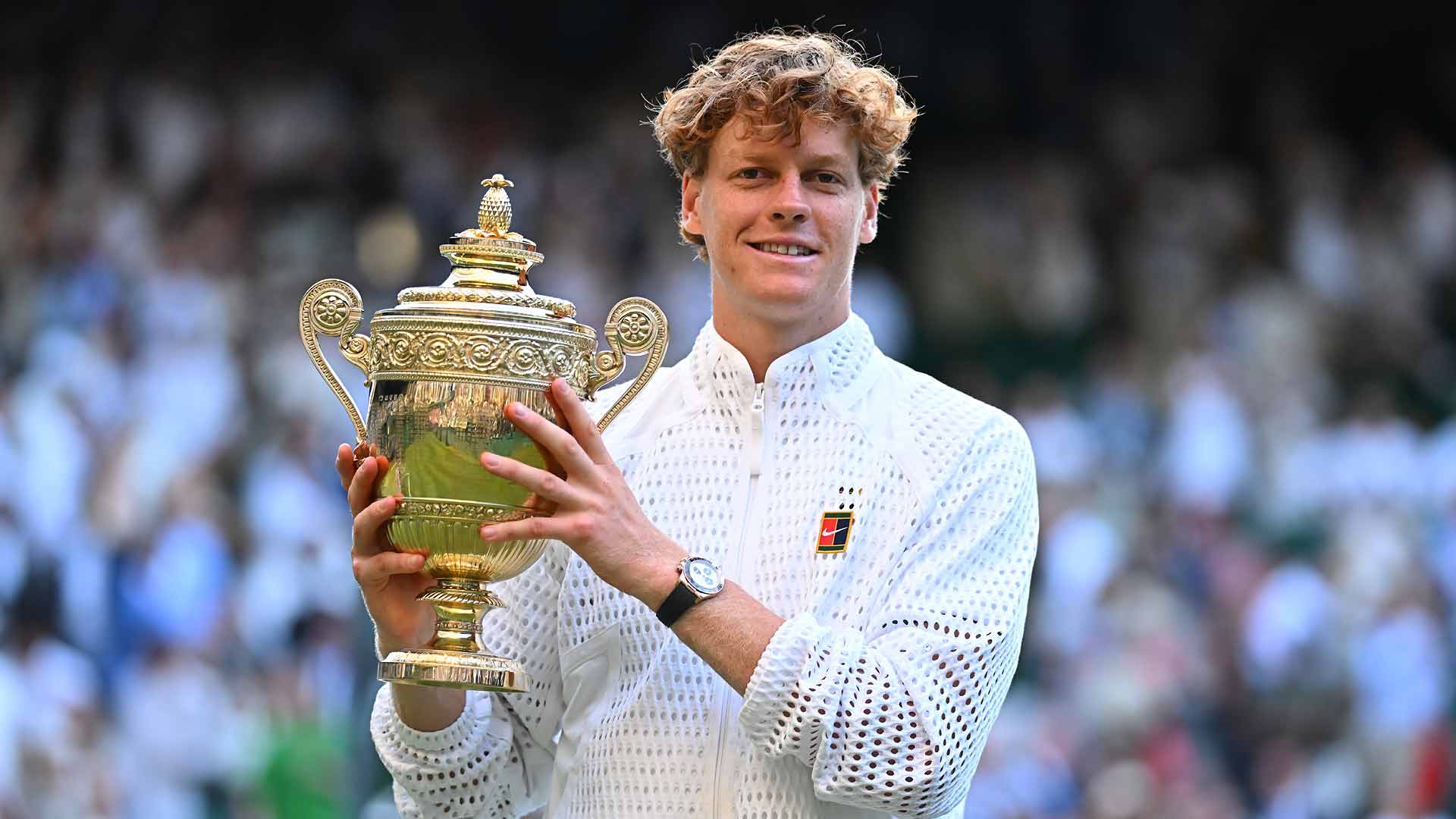
The serve took years to rebuild, not weeks, but Sinner's team is unusually quick at identifying which developing tool a defeat demands. After a shaky opening Monday, Sinner had turned the tournament into a serving masterclass and defended his title by Championship Sunday.
Wimbledon did not prove that Sinner cannot be beaten. The advanced statistics make the requirements pretty measurable: hold often enough to keep the score neutral, put first serves back without donating errors, attack the second delivery, disrupt court geometry from strong positions, and change the pattern before Sinner does.
The rest of men's tennis must act fast, as the tectonic plates continue to push Mount Sinner's peak higher.